


Disclosure: This post contains affiliate links. If you buy through these links, Antifoodie may earn a commission at no extra cost to you.
Every kitchen has a knife drawer with one dull blade nobody wants to admit is dull. You’ve been sawing through tomatoes instead of slicing them for months, telling yourself it’s the tomato’s fault. It isn’t. It’s the knife.
The Work Sharp Culinary E5 showed up promising to fix that in under a minute, using the same belt-sharpening technology the company built its name on for hunting and outdoor knives, just scaled down for a kitchen counter. It’s not cheap, and it’s not subtle about what it is: a small motorized belt sander for your knives. That’s a strange thing to put next to your stand mixer.
We put it through real use on a mixed set of kitchen knives, from a beat-up starter chef’s knife to a Japanese gyuto that deserved better care than it was getting, and stacked it against three cheaper sharpeners people actually buy instead. Here’s whether the E5 earns its spot on the counter or belongs in the “should have bought the cheap one” pile.
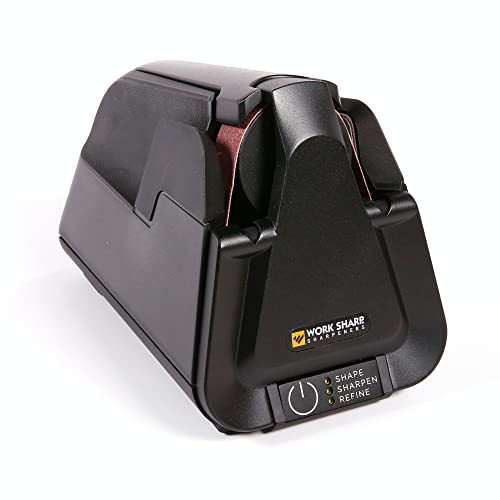
What It’s Actually Like to Use
You pick a slot (there are five belts: coarse to extra-fine, plus a leather strop for polishing), drop the knife into a guided angle groove, and pull it through a few times per side. The motor does the work. The whole process, start to finish on a moderately dull knife, took us under two minutes including belt swaps. On a knife that just needed a touch-up, it was closer to 20 seconds.
The angle guides are the actual selling point here. Freehand sharpening on a stone lives or dies on keeping a consistent angle for hundreds of strokes, which is exactly where most home cooks (us included, before this) mess it up. The E5 removes that variable. You’re not guessing at 17 degrees, you’re locked into it.
It’s genuinely loud, closer to a small power tool than a kitchen gadget, and it throws a fine dust of metal shavings you’ll want to wipe down after. Neither is a dealbreaker, but don’t expect something you can run quietly before the household wakes up.
The belts themselves are a maintenance item worth knowing about before you buy. They wear down with use, same as sandpaper, and Work Sharp sells replacement sets separately. For a home kitchen sharpening a handful of knives every few months, one set of belts lasts a long time. If you’re sharpening for a whole household or doing it weekly, budget for replacements the same way you’d budget for a new sponge.
What’s Good
The edge it produces is sharp in a way a lot of home cooks haven’t felt since they bought the knife. We tested it on a $40 starter knife and it came out cutting tomato skin without pressing down, cleanly, first pass. That’s the E5’s whole pitch and it delivers.
The angle guides mean consistent results every time, which matters more than raw sharpness for most people. A knife that’s sharp but unevenly ground rolls and chips faster. This one comes out even.
Speed is real. If you’re the type who lets knives go dull because sharpening feels like a chore, a sub-minute process removes the excuse. We’ve kept up with it for weeks specifically because it doesn’t feel like a project.
What’s Not
Belt sharpeners remove metal, more of it than a whetstone, and more than the manual pull-through sharpeners below. Every pass through the coarse belt is shaving material off your blade. Use it as your only sharpening method every week and you’ll wear down a knife’s lifespan faster than you would with gentler methods. It’s built for periodic real sharpening, not weekly maintenance.
It’s also not cheap for what is, mechanically, a small belt sander. At $149.95 it costs more than some of the knives people will be sharpening with it, and that math doesn’t sit right for everyone.
The tip control takes a little practice. On the first couple of knives we slightly rounded the very tip because we didn’t ease off the pressure at the end of the stroke the way the manual says to. Not a huge deal, but it’s a real learning curve, not a “so easy a child could do it” claim some reviews make.
How It Compares
The E5 isn’t the only way to get a knife sharp. Here’s how it stacks up against three sharpeners people commonly buy instead, from a mid-range electric competitor down to sharpeners that cost less than a takeout order.
| Product | Price | Best For | |
|---|---|---|---|
| Work Sharp Culinary E5 (Editor’s Pick) | $149.95 | Cooks who want the sharpest possible edge in under a minute | Amazon |
| Chef’sChoice 130 | See listing | A gentler, set-and-forget electric option for nervous first-timers | Amazon |
| KitchenIQ 50009 Edge Grip | $10.07 | Anyone who just wants “not dull” between real sharpenings | Amazon |
| AccuSharp Knife Sharpener | $11.99 | A backup drawer tool or a starter sharpener for a first apartment | Amazon |
The Chef’sChoice 130 is the closest real competitor. It’s also electric, also uses angle guides, and it’s a genuinely reliable machine that’s been a kitchen staple for years. It’s gentler on the blade and less intimidating for a first-time buyer, but it doesn’t get the edge quite as keen as the E5’s belt system, and the guides on ours felt a bit loose after a couple years of use in past testing of the line.
The KitchenIQ and AccuSharp are in a different category entirely: manual pull-through sharpeners you drag the blade through by hand. Both work fine for keeping a Western kitchen knife from going fully dull between real sharpenings, and at around $10 to $12, neither is a real financial decision. Neither will get you the same edge as an electric system, and pull-through carbide sharpeners can be rough on a nicer Japanese blade if you use them too often.
None of these four is a bad buy at what it’s asking. The honest way to think about it is a ladder: the AccuSharp and KitchenIQ are backup-drawer tools, the Chef’sChoice is the safer everyday electric pick, and the E5 is what you reach for when you actually want the best edge your knife is capable of holding.
Should You Buy It?
If you already invested in a good knife (we’ve made the case for spending real money on a chef’s knife before), the E5 is the maintenance that protects that investment. A great knife that’s dull isn’t a great knife, it’s just an expensive one. Keeping the edge up is what makes the difference actually show up in your cooking, the same way keeping a cast iron pan seasoned is what makes it worth owning at all.
Skip it if knife work isn’t really the bottleneck in your kitchen. If most of your prep time goes to dicing onions and mincing garlic in bulk, a good vegetable chopper solves a different problem and does it for less money than this sharpener costs. And if you own one knife and use it twice a week, a $10 pull-through sharpener will keep you fed just fine.
The Practical Move
If you cook often enough to notice a dull knife, get the Work Sharp Culinary E5 and stop dreading tomatoes. If sharpening is a once-a-year afterthought, save the money and grab the KitchenIQ instead.
Work Sharp Culinary E5 FAQ
Is the Work Sharp Culinary E5 worth the price?
If you cook regularly and care about your knives, yes. It’s a genuine step up from manual sharpeners in speed and edge quality. If you sharpen once a year, it’s more machine than you need.
How often should you sharpen a kitchen knife?
Most home cooks get away with a real sharpening every one to three months and a quick hone between, depending on how often you’re cutting and what you’re cutting on. A cutting board with a lot of glass or ceramic contact will dull a blade faster than wood.
Will the Work Sharp E5 damage my knife?
Used as directed, no, but it does remove more metal per pass than a whetstone or a manual sharpener. Reserve the coarsest belt for knives that are actually dull, not for weekly touch-ups.
Can you use it on serrated knives?
Yes, the E5 includes guides for serrated edges, though it’s slower and takes more attention than straight blades since you’re working each individual serration.
What’s the difference between honing and sharpening?
Honing straightens a rolled edge that’s still technically sharp, which is what a honing steel does between real sharpenings. Sharpening actually removes metal to create a new edge, which is what the E5 and every product on this list does.
Is a sharp knife actually safer than a dull one?
Yes. A dull blade needs more force to cut, which means more slips, and OSHA’s own guidance on sharp knives in food service work backs up what any line cook will tell you: a sharp knife is the safer knife.


