Disclosure: This post contains affiliate links. If you buy through these links, Antifoodie may earn a commission at no extra cost to you.
Almost every wok recommendation you will read was written for a kitchen you do not have. It assumes a jet engine under the pan, the kind of burner that throws flame up the sides and gets steel glowing in forty seconds.
Your stove does not do that. A normal home burner, gas or electric, puts out a fraction of that heat, and an electric element is flat while a traditional wok is round.
So the real question is not which wok a restaurant would buy. It is which wok actually works on a home stove, and the answer comes down to two things: a flat bottom that makes full contact with your burner, and metal thin enough to heat up fast on modest power.
These five clear that bar. We also flag the one shape to walk away from, because it is the most common mistake people make with their first wok.
The Five at a Glance
| Wok |
Price |
Material |
Best For |
|
| Souped Up Recipes 12.5 inch (Editor’s Pick) |
$39.99 |
Carbon steel |
Electric and induction, first wok |
Amazon |
| Yosukata 13.5 inch Black |
$62.99 |
Carbon steel |
More cooking surface, gas burners |
Amazon |
| Lodge Chef Collection 12.5 inch |
$59.90 |
Cast iron |
Weak burners that need stored heat |
Amazon |
| Craft Wok Hand Hammered 14 inch |
$65.75 |
Carbon steel |
Strong gas burners, real tossing |
Amazon |
| Joyce Chen Classic 14 inch |
$59.95 |
Carbon steel |
A familiar name, long handle |
Amazon |
Editor’s Pick
Souped Up Recipes 12.5 Inch: The One Built for the Stove You Own

This is the one we would hand somebody buying their first wok, and at $39.99 it is also the cheapest thing on this page.
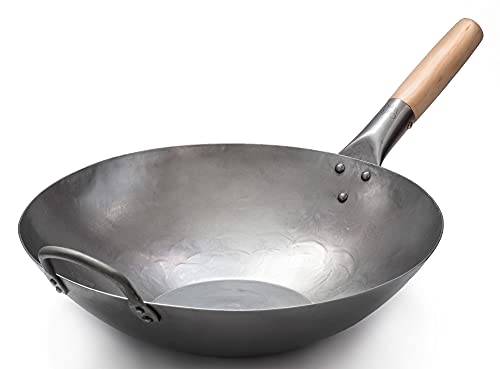
Souped Up Recipes designed it around home equipment rather than restaurant equipment. The bottom is genuinely flat, the steel is thin enough to come up to heat on a mediocre burner, and the base is magnetic so induction cooktops see it.
At 4.5 stars across 9,836 reviews it has the deepest track record here by a wide margin. A lid and a spatula come in the box, and the lid matters more than people expect because a home burner often needs a brief cover to finish dense vegetables.
The honest drawbacks start with size. At 12.5 inches it is comfortable for two or three portions and crowded for four, and crowding a wok is how stir fry turns into stew.
The steel is also on the thin side, which is the tradeoff that makes it heat fast. Run it screaming hot and then hit it with cold water and you can warp it. The included spatula is fine, not great.
Best for: Electric and induction cooktops, and anyone who wants to find out whether they actually like cooking in a wok.
Yosukata 13.5 Inch: More Room, Shakier Seasoning
Yosukata is the wok you see recommended constantly, and the extra inch of diameter over our top pick is a real advantage if you cook for four.
The shape is good. Flat bottom, high sloping sides, light enough to lift with one hand, and the finish is a proper blackened carbon steel rather than a coating.
But look at the rating. It sits at 4.2 stars across 5,548 reviews, the lowest score in this group, and the complaints are consistent rather than scattered.
The recurring theme is the factory seasoning. It arrives uneven often enough that plenty of owners end up stripping it back to bare metal and seasoning it themselves, which is a two hour job you did not sign up for when you paid $62.99.
If you are comfortable seasoning carbon steel from scratch, none of that bothers you and this is a lot of wok. If you are not, the same money buys a less annoying start somewhere else on this list.
Seasoning carbon steel is the same process we walked through for carbon steel skillets, so if you have done one you can do the other.
Best for: Gas burners and bigger batches, if you do not mind re-seasoning it yourself.
Lodge Chef Collection 12.5 Inch: For Burners That Cannot Keep Up
Cast iron solves the home burner problem from the opposite direction. Instead of heating fast, it stores a large amount of heat and then refuses to give it up when cold food lands.
That is exactly what you want on a weak electric element, where a thin wok drops forty degrees the moment a pound of broccoli hits it and never recovers.
Lodge makes this one in the US, pre-seasoned, and it holds 4.7 stars, the highest rating on this page.
The catch is that 4.7 comes from only 88 reviews, which is a much thinner track record than the thousands behind the carbon steel options. Treat it as promising rather than proven.
The bigger catch is weight. A cast iron wok is heavy before you put food in it, so the flipping and tossing that makes wok cooking fun is mostly off the table. You stir, you do not toss.
It is also slow. Give it a full five to eight minutes to preheat, and accept that you cannot dial the temperature down quickly once it is hot.
One genuine side benefit: a systematic review indexed in the NIH library found that cooking in iron cookware raises the iron content of the food and can nudge blood hemoglobin. The authors are careful to note the trials are few and the effects modest and inconsistent, so treat it as a small bonus rather than a reason to buy.
Best for: Underpowered electric coil and glass top ranges, and cooks who would rather stir than toss.
Craft Wok Hand Hammered 14 Inch: The Real Thing, With Real Conditions
This is the wok people mean when they talk about a proper pow wok. Craft Wok hand hammers these, and the dimples are not decoration, they give food somewhere to rest up the sides while you work the bottom.
At 14 inches with 4.4 stars across 2,158 reviews it is the choice for somebody who already knows they like stir frying and wants the tool a cook would actually use.
Now the conditions, because there are several and they matter more here than on anything else in this list.
It is the most expensive wok here at $65.75, and it wants a strong gas burner. On a modest electric element a 14 inch wok has more cold metal than your stove can heat, and you will cook in a small circle at the bottom.
The wooden helper handle is not oven safe, so the broiler finish and the oven braise are both out. The hammered surface also takes longer to season evenly than a smooth one, because the low spots hold oil differently than the high spots.
Not the one we would reorder for somebody with a glass top range. On a good gas burner it is the best cooking experience on this page.
Best for: Confident cooks with a strong gas burner who want to actually toss food.
Joyce Chen Classic 14 Inch: The Familiar Name
Joyce Chen has been the default wok in American kitchens for decades, and this pre-seasoned Classic is the current version of a pan a lot of people learned on.
The long wooden handle is the real selling point. It stays cool, it gives you leverage, and it makes a 14 inch wok manageable on a stove where you have to work at arm’s length.
Here is where we have to be careful with you. This specific pre-seasoned SKU only has 121 reviews at 4.3 stars, and the longer running Joyce Chen listings for near identical woks sit lower, in the high threes to low fours.
That pattern usually means the design is fine and the quality control is inconsistent, which lines up with the recurring complaint on the older versions: handles that work loose at the ferrule after a year or two of heat cycles.
Fine, but not essential. You are buying a known name rather than the best wok at this price, and $59.95 buys the Souped Up Recipes wok plus a decent spatula with change left over.
Best for: Anyone who wants the long handle and does not mind paying a little for the familiar name.
Why Most Wok Advice Does Not Apply to Your Home Stove
Restaurant wok burners are a different category of appliance. They wrap flame around a round bottom and keep the metal hot no matter what you throw in it, which is where the smoky quality people chase actually comes from.
A home burner cannot do that, and no wok fixes it. What a good wok can do is waste less of the heat you do have.
That is why flat bottom is not a compromise, it is the requirement. A round bottom wok on a flat electric element touches at roughly a coin sized spot, so you heat a coin sized spot.
Those cheap ring stands that come with round bottom woks make it worse rather than better. They lift the pan further from the element and add an air gap, which is the opposite of what a weak burner needs.
Thin metal is the second requirement, and it is why we would steer you away from a nonstick wok entirely. Stir frying wants the pan hotter than any coating is happy at, and a coating that gets abused eventually stops working, which is the same story as nonstick pans giving out.
The last thing nobody mentions: cook in smaller batches than you think. Two portions at a time, not four. On a home stove, batch size is the single biggest lever you have over whether the food sears or steams.
Which One Should You Actually Buy?
Get the Souped Up Recipes 12.5 inch if you are not sure. It is forty dollars, it was designed around home burners, and almost ten thousand reviewers agree it works. If you discover woks are not your thing, you are out very little.
Get the Lodge cast iron if your electric range is genuinely weak and food keeps steaming instead of searing. Stored heat beats fast heat when the stove is the bottleneck.
Get the Craft Wok if you have a strong gas burner and you already know you like this kind of cooking. It is the best pan here and the least forgiving.
Get the Yosukata if you want the extra inch and you are willing to season it properly yourself.
The Joyce Chen is the one we would skip unless the long handle is specifically what you are after.
Whichever you get, the thing that makes a stir fry taste like something is what goes in at the end, and a spoonful of good chili crisp does more for a weeknight plate of noodles than any amount of pan upgrading.
The Practical Move
Buy the Souped Up Recipes wok, cook two portions at a time instead of four, and let the pan get properly hot before anything goes in. That costs forty dollars and fixes most of what people blame on their stove.
Start with the Souped Up Recipes Wok
Home Stove Wok FAQ
Do I need a flat bottom wok for an electric stove?
Yes. A round bottom wok only touches a flat element at a small central point, so most of the pan never gets hot. Flat bottom is the single most important spec for any electric or induction cooktop.
Is carbon steel or cast iron better for a wok?
Carbon steel for most people, because it heats quickly and is light enough to move food around. Choose cast iron instead if your burner is weak, since it stores heat and recovers better when cold food hits the pan.
Will a wok work on an induction cooktop?
Only if it has a flat magnetic base, which both carbon steel and cast iron do. Hold a fridge magnet to the bottom before you buy, and skip any wok with a rounded or warped base because induction needs full contact.
Should I buy a nonstick wok?
No. Stir frying wants the pan hotter than nonstick coatings tolerate, so you either ruin the coating or cook too cool to get any browning. Seasoned carbon steel becomes its own slick surface with use.
What size wok is right for a home kitchen?
Twelve to fourteen inches covers nearly everyone, and smaller is better than bigger on a weak burner. A 14 inch wok on a modest electric element has more cold metal than your stove can heat.
Why does my stir fry come out watery instead of seared?
You are almost certainly crowding the pan. Cook in two batches rather than one, get the wok fully preheated first, and pat wet vegetables and proteins dry before they go in.
Buy for the burner you have, not the one in the video. That is the whole trick.