


Disclosure: This post contains affiliate links. If you buy through these links, Antifoodie may earn a commission at no extra cost to you.
Every November somebody asks us whether they actually need a real roasting pan for Thanksgiving, usually while standing in a store aisle holding a flimsy foil tray in one hand and reading the price tag on a slab of stainless steel with the other. Both of those things do the same job on paper. They hold a bird up off the bottom of a hot oven and catch what drips out of it.
The price spread between them is enormous, which is the whole problem. Nobody wants to spend real money on a pan that lives in a basement eleven months a year, and nobody wants their turkey to hit the oven floor either. We have cooked birds in all of it: the disposable tray that buckled on the way out, the enamel roaster that gets dragged up from storage once a season, the heavy stainless one that doubles as the gravy pot.
So here is the honest version, broken out by tier, with what the money actually buys and what it very much does not. We went through the same exercise with a $200 chef’s knife versus a $40 one, and the shape of the answer is similar: the jump from cheap to decent is huge, and the jump from decent to expensive is mostly for people who use the thing constantly.
The Four Tiers at a Glance
| Pan | Price | Stovetop Gravy | Best For | |
|---|---|---|---|---|
| Reynolds Kitchens Heavy Duty Aluminum Roasting Pan | See listing | No | One bird a year, zero storage space | Amazon |
| Granite Ware Large Covered Oval Roasting Pan, 18 inch | See listing | Not really | Big birds, hams, anything you want to cover | Amazon |
| Cuisinart Chef’s Classic 16 inch Roasting Pan with Rack (Editor’s Pick) | $79.95 | Yes | Anyone roasting more than once or twice a year | Amazon |
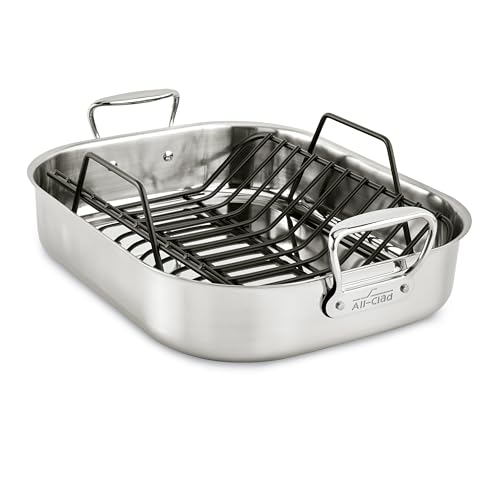
| All-Clad Stainless Steel 13 by 16 inch Roaster with Rack | $149.95 | Yes, and well | People who roast and braise year round | Amazon |


What the Extra Money Actually Buys You
Three things, and only three. Everything else is marketing.
A flat, layered base you can cook on. This is the big one and it is the only reason to move past a foil pan. A pan that sits flat across a burner and conducts heat without a hot ring in the middle lets you make gravy in the drippings instead of scraping them into a saucepan and losing half the flavor to the transfer. Everything from the Cuisinart up does this. Nothing below it does.
Handles that hold a loaded bird. Riveted stainless handles let you pull 18 pounds out of a hot oven with confidence. Rolled foil edges and thin enamel loops do not. This is a safety feature pretending to be a convenience feature.
Sides that do not scorch. Fully clad walls, which really only arrive at the All-Clad tier, keep the corners from burning when the liquid cooks down. If you have ever had a pan of vegetables go from golden to black in the two inches nearest the edge, that is what you are paying to fix. It is a real problem and a real fix, just a narrow one.
What It Doesn’t Buy You
It does not buy you a juicier turkey. Moisture comes from not overcooking the breast, which is a thermometer problem, not a pan problem. The USDA puts the safe finish line at 165 degrees in the innermost thigh and the thickest part of the breast, and every degree past that is moisture you are paying for and throwing away. The USDA’s own Thanksgiving guidance is worth two minutes of your time, and it will do more for your bird than any amount of stainless.
It does not buy you crispier skin either. Skin gets crisp from dry surface and airflow, which means a rack and an uncovered final stretch. A foil pan with a rack set in it will out crisp a $150 pan with the bird sitting flat in its own juices.
And it does not buy you a nonstick surface that lasts. None of these are coated, which is actually the point. Coated roasting pans exist and they are the one category we would steer you away from, for the same reason nonstick pans stop working: you are going to run high heat and metal utensils through this thing, and a coating in a roasting pan is a countdown clock.
Which Tier Is Right for You?
If Thanksgiving is the only time a large bird enters your oven, buy the Reynolds foil pan, put it on a rimmed baking sheet, and add a cheap rack. You will spend less than lunch costs and your results will be fine. We mean that.
If you want something reusable that handles a genuinely big turkey and you like the lid, the Granite Ware 18 inch oval is the move. Just accept that gravy happens elsewhere and the enamel will pick up a chip eventually.
If you roast anything other than the holiday bird, get the Cuisinart Chef’s Classic. It is the only tier in this list where the upgrade changes what you can cook instead of just how the pan looks, and it is the one we would put on a list of gifts for whoever is hosting. Easy recommend.
Buy the All-Clad only if you already know you are the person who roasts and braises year round. If you are asking whether you need it, you do not.
The Practical Move
Get the Cuisinart Chef’s Classic 16 inch with the rack. It is the cheapest pan here that lets you make gravy in the drippings, and that single capability is worth more than every other upgrade on this page combined.
Roasting Pan FAQ
Do you actually need a roasting pan for Thanksgiving?
No. A heavy duty foil pan set on a rimmed baking sheet, with a rack inside it, will roast a turkey perfectly well. You need a real pan when you want to make gravy on the stovetop in the same vessel.
Can you roast a turkey in a disposable aluminum pan?
Yes, and plenty of people do it every year. The one rule is to put the foil pan on a rimmed baking sheet before you load it, because a full pan flexes badly and that is how turkeys end up on the floor.
What size roasting pan do I need for a 20 pound turkey?
A 16 inch rectangular pan is tight for 20 pounds and a fight at 22. If your family does birds that size, go with an 18 inch oval roaster instead.
Is an All-Clad roasting pan worth it?
Only if you roast and braise year round. The fully clad sides really do stop the corners from scorching, but that advantage is invisible if the pan comes out of storage twice a year.
Can you make gravy in a roasting pan on the stovetop?
You can if the pan has a flat, layered base, which means stainless like the Cuisinart or the All-Clad. Enamel oval roasters and foil pans do not sit flat or heat evenly on a burner, so transfer the drippings to a saucepan instead.
Do you need a rack in a roasting pan?
Yes, or something standing in for one. A rack lifts the bird out of its drippings so the skin can dry and crisp, and a bed of thick cut onions and carrots does the same job if you do not own one.
Buy for the cooking you actually do the other 51 weekends, not for the one Thursday in November. That is the whole decision.


