⚠️ Disclosure: This post contains affiliate links. If you buy through these links, Antifoodie may earn a commission at no extra cost to you.
I didn’t own a kitchen scale until a sourdough starter humbled me. Cups of flour lie to you — scoop-and-level can swing 20% depending on how hard you pack it, and that’s the difference between bread and a brick. Once I started weighing instead of measuring, I stopped guessing and started actually replicating recipes.
But a scale is also one of those things where the $10 version and the $65 version both technically “work,” and the gap between them only shows up after you’ve used one for a few months and started noticing what annoys you. A wobbly display you can’t see under a mixing bowl. A battery door that pops off if you look at it wrong. Accuracy that drifts the second you’re weighing something small, like yeast or espresso.
I looked at five scales that keep showing up at the top of Amazon’s kitchen category and in cooking forums, from a scale that costs less than a sandwich to one serious home bakers swear by. Here’s what’s actually worth your counter space.
Quick reality check before we get into it: almost every scale on Amazon will get you within a gram or two of correct, which is fine for most cooking. Where they actually differ is in the stuff you only notice after a few months of daily use — can you read the display with a big bowl on it, does the battery door survive being opened a hundred times, does it drift when you’re weighing something small like yeast or espresso grounds. That’s what separates the $11 scales from the $65 one below.
⭐ Our Top Pick
OXO Good Grips 11-Pound Food Scale — Worth the Extra Money

The pull-out display alone justifies the price if you’ve ever tried to read a scale hiding under a big mixing bowl. It’s accurate, it’s sturdy, and it’s the one I’d replace first if mine broke.
Quick Comparison: All 5 at a Glance
| Product |
Price |
Best For |
|
| ⭐ OXO Good Grips 11-lb |
~$65 |
Anyone who wants the best all-around scale |
Amazon → |
| Amazon Basics Digital Scale |
~$13 |
Best budget pick, no frills |
Amazon → |
| Etekcity Food Scale |
~$11 |
Splash resistance, USB-C charging |
Amazon → |
| Escali Primo |
~$25 |
Small-kitchen, portion control |
Amazon → |
| My Weigh KD-8000 |
~$50 |
Serious/frequent bakers |
Amazon → |
⭐ Editor’s Pick
OXO Good Grips 11-Pound Food Scale: The One That Solves the Big-Bowl Problem (~$65)
Every scale has the same flaw: you put a big mixing bowl on it and now you can’t see the number. OXO fixed that with a pull-out display that slides forward from under the platform, so you can actually read it with a stand mixer bowl parked on top. It sounds like a small thing until you’ve fought with a scale for the tenth time this month.
It’s also just accurate — consistent gram-for-gram in testing, with a 30-minute auto-off timer that’s long enough to survive a slow bread-proofing session without shutting off mid-weigh. The stainless steel platform pops off for cleaning, which matters more than it sounds like it should when you’re weighing raw chicken one minute and flour the next.
The catch is the price. $65 is a lot for something that, at the end of the day, tells you a number. If you cook seriously enough that a scale lives permanently on your counter, it earns that price back in fewer ruined recipes. If you’ll use it twice a year for holiday baking, it’s overkill.
Best for: People who bake or cook by weight often enough that visibility and durability matter more than saving $50.
Usually $55–$70 · 4.7 stars, nearly 9,000 ratings
Amazon Basics Digital Kitchen Scale: The One Everyone Actually Owns (~$13)
Over 118,000 ratings and a 4.7-star average is not a fluke — this is the scale that ends up in the most kitchens because it does the one job without asking for anything in return. LCD display, tare function, weighs up to 11 pounds, takes AAA batteries and just works.
It’s not fancy. The display sits flush on the platform, so the big-bowl problem exists here too, and the plastic housing won’t survive being dropped repeatedly. But for the price of two coffees, it’s hard to find a real complaint that isn’t “I wish it cost more so I’d feel better about it.”
Best for: First-time scale buyers, dorm kitchens, anyone who just wants accurate numbers without the upsell.
Usually $10–$15 · Batteries included
Etekcity Food Kitchen Scale: Great in the Sink, Iffy at 1 Gram (~$11)
Etekcity is the most-reviewed scale on this list by a wide margin, and it’s earned that with a couple of genuinely useful features the others skip: a rechargeable battery that charges over USB-C instead of eating AAAs, and an IPX6 water-resistance rating, meaning it can handle a direct splash or a rinse under the faucet without dying.
The tradeoff is accuracy at the low end. In side-by-side testing it’s been inconsistent at 1–2 grams — it can miss small weights or drift a gram off, which matters if you’re measuring espresso doses or yeast, and matters a lot less if you’re portioning meal-prep chicken.
Best for: Meal preppers and anyone who wants a scale that can survive living next to the sink.
Usually $9–$13 · Skip it if you weigh coffee or yeast to the gram
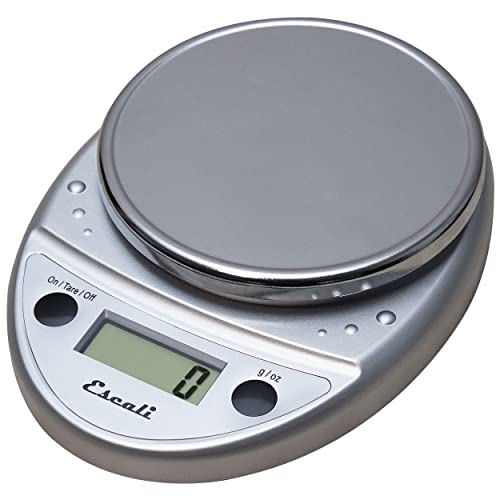
Escali Primo: The Small, Precise One (~$25)
Escali doesn’t try to do anything clever — it’s a compact chrome scale, about the size of a small book, that’s built for accuracy and portion control rather than handling a five-quart mixing bowl. It’s a favorite among people who track macros or bake in smaller batches, since it reads in precise increments without the display lag some cheaper scales have.
The small footprint is also its limit. If you’re weighing a big batch of dough or a whole roast, you’ll outgrow the platform fast. This is the scale for portioning, not for production.
Best for: Small kitchens, portion control, anyone who doesn’t need to weigh anything bigger than a mixing bowl.
Usually $20–$28 · Great gift for the portion-control crowd
My Weigh KD-8000: The One Serious Bakers Actually Recommend (~$50)
This is the scale that shows up unprompted in bread and pastry forums. It’s built with a removable stainless top plate, handles up to 17.6 pounds, and holds 0.1-gram precision even at higher loads — which matters if you’re scaling a recipe up and need your hydration percentages to stay honest.
It’s not the most attractive scale on this list, and the buttons feel more industrial than premium. But nobody’s buying this one for the looks. It’s a workhorse, and the people who own it tend to keep it for years.
Best for: Frequent bakers who care about hydration ratios and consistent results more than counter aesthetics.
Usually $45–$55 · Overkill unless you bake weekly
Which One Should You Actually Buy?
If you cook or bake often enough to know your current cup-measuring is inconsistent, get the OXO. The pull-out display genuinely changes how often you’ll reach for it, and it’ll outlast the cheaper options. If you just want to stop guessing without spending real money, the Amazon Basics scale does the job for the price of lunch. If you bake bread or pastry on a regular schedule and care about hydration percentages, skip straight to the My Weigh — it’s the one people who bake for a living actually recommend. Skip the Etekcity if precision at low weights matters to you; grab it if you want something that can live next to your sink and survive a splash.
One more thing worth knowing before you buy: capacity matters more than people expect. An 11-pound scale sounds like plenty until you’re weighing a big Dutch oven full of stew or a whole turkey, and the scale maxes out and just flashes an error. If you cook in large batches or work with big cuts of meat, the higher-capacity My Weigh is worth the extra money over a scale that tops out at 11 pounds. For everyday portioning — flour, sugar, produce, meal-prep containers — any of the scales here will cover you fine.
👋 The Practical Move
Start with the OXO if you can spend the money — it’s the scale you won’t replace in two years. If budget’s the deciding factor, the Amazon Basics gets you 90% of the way there for a fifth of the price.
Start with the OXO 11-lb →
None of these will make you a better cook by themselves. But they’ll stop you from blaming a recipe for a problem that was actually your flour measurement the whole time. Set it on the counter where you’ll actually see it — a scale that lives in a drawer is a scale you’ll stop using within a month.